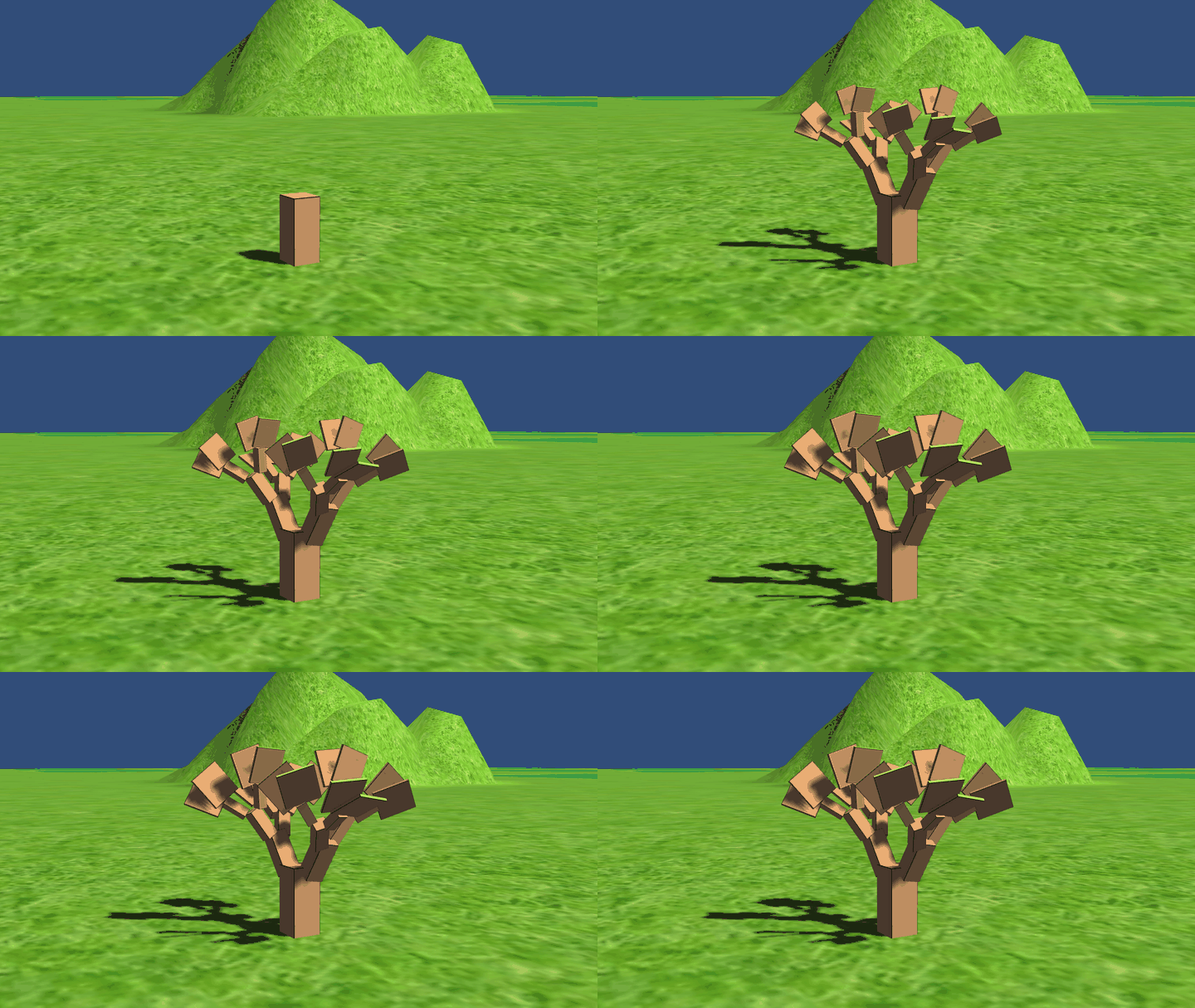
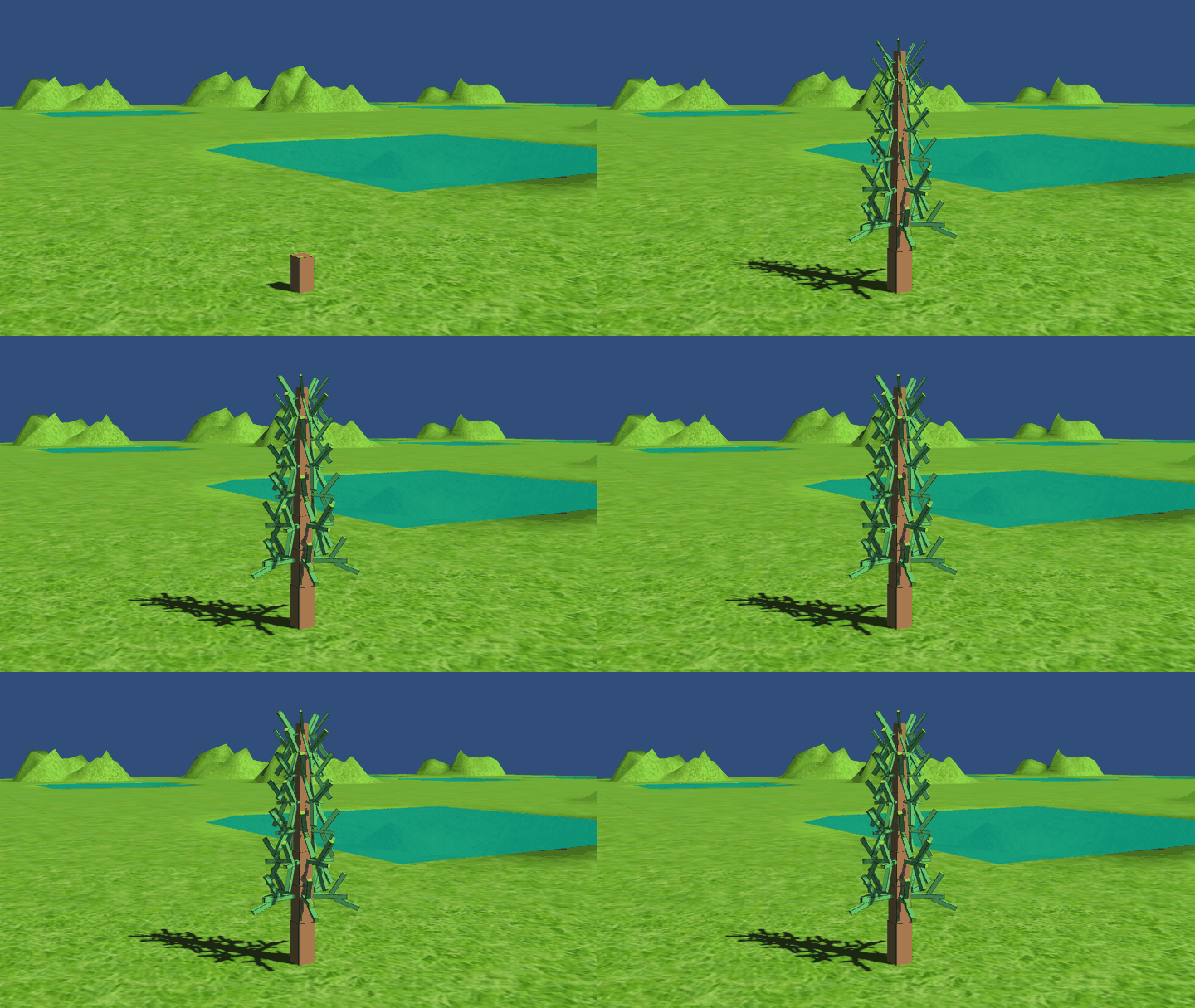
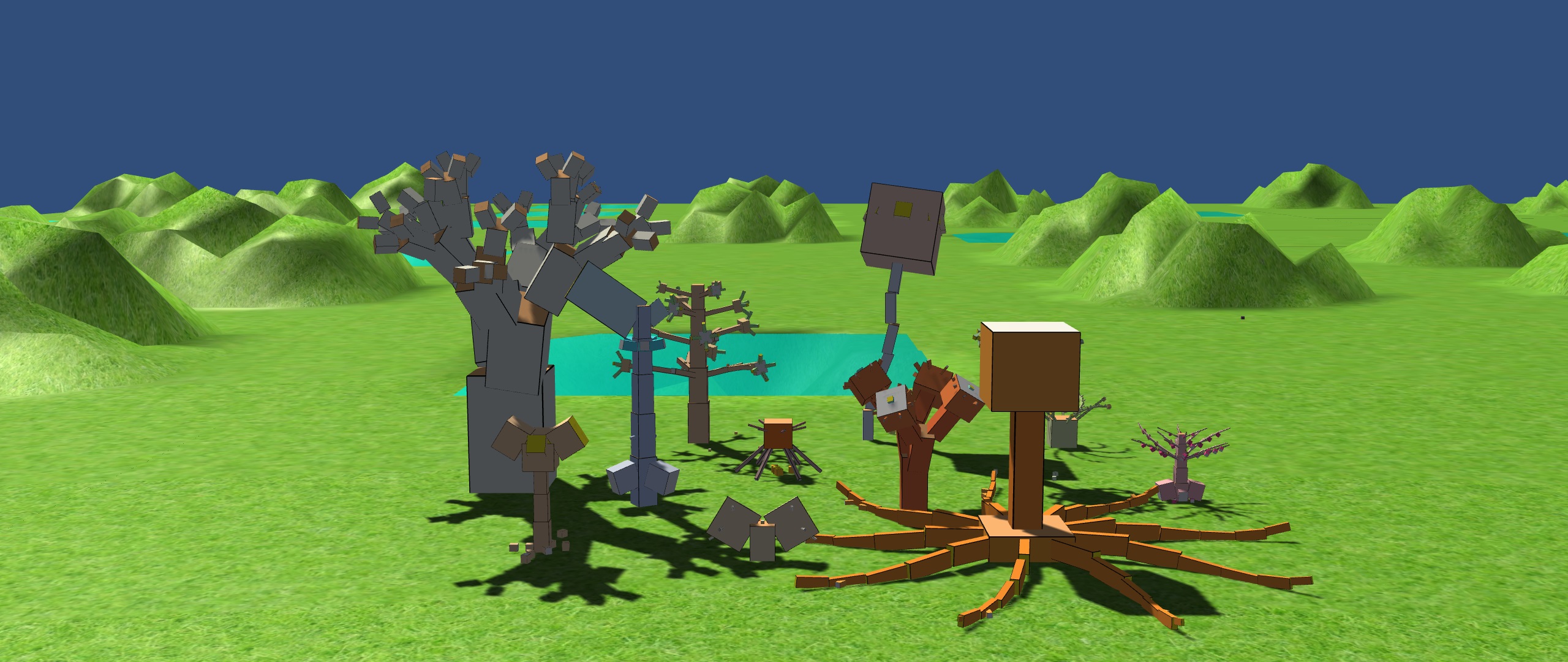
People ask what’s “real” in these worlds and what’s animation. Short answer: nothing is animated. Here is the list of what the engine actually computes, with the numbers.
1: Physics
Every part is a rigid box in PhysX, density 1 – an 11 cm leg weighs 4.5 g. Joints are spring-damper drives.
2: Chemistry
Each part is a cell holding glucose, nutrient and biosynthate in tubes packed into its cross-section – a thicker part stores more, and that’s the only capacity there is. Reactions are stoichiometric and stepped with forward Euler: leaves make glucose, roots import nutrient, glucose + nutrient → biosynthate, which pays for everything.
Chemicals diffuse between joined parts on a fullness gradient.
Eating is a transfer : a mouth draws from whatever edible cell overlaps it.
3: Costs
- Upkeep: 0.003 biosynthate per m² of surface per second, same for every tissue (surface, not volume – square-cube law).
- Motion: joint torque × spin, integrated to joules, charged at 0.1 glucose per joule. A leg that can’t pay goes limp in proportion.
- Growth: 20 biosynthate per m³ built.
4: Light, and why the plants are the shape they are
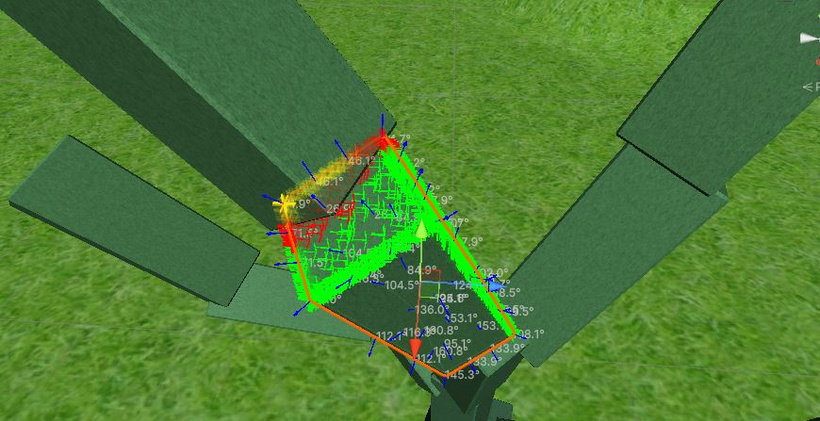
A leaf’s income is its sky-visible area, measured by casting rays: sample points on every face within 60° of upward, 5 per m², each one cast straight up through the real scene. 4 glucose/s per m² seen.
A leaf under another leaf earns less, a seedling under a canopy earns less, and nobody wrote a shading rule.
New growth then steers toward the light – eight rays, weighted by how far each one gets – and upkeep removes what the light doesn’t pay for. The same genome in shade stays stunted next to its well-lit twin. T
5: Water
Buoyancy is made through a Monte Carlo: submerged volume = fraction below the surface × volume, force at the centroid of the wet points.

6: Growth
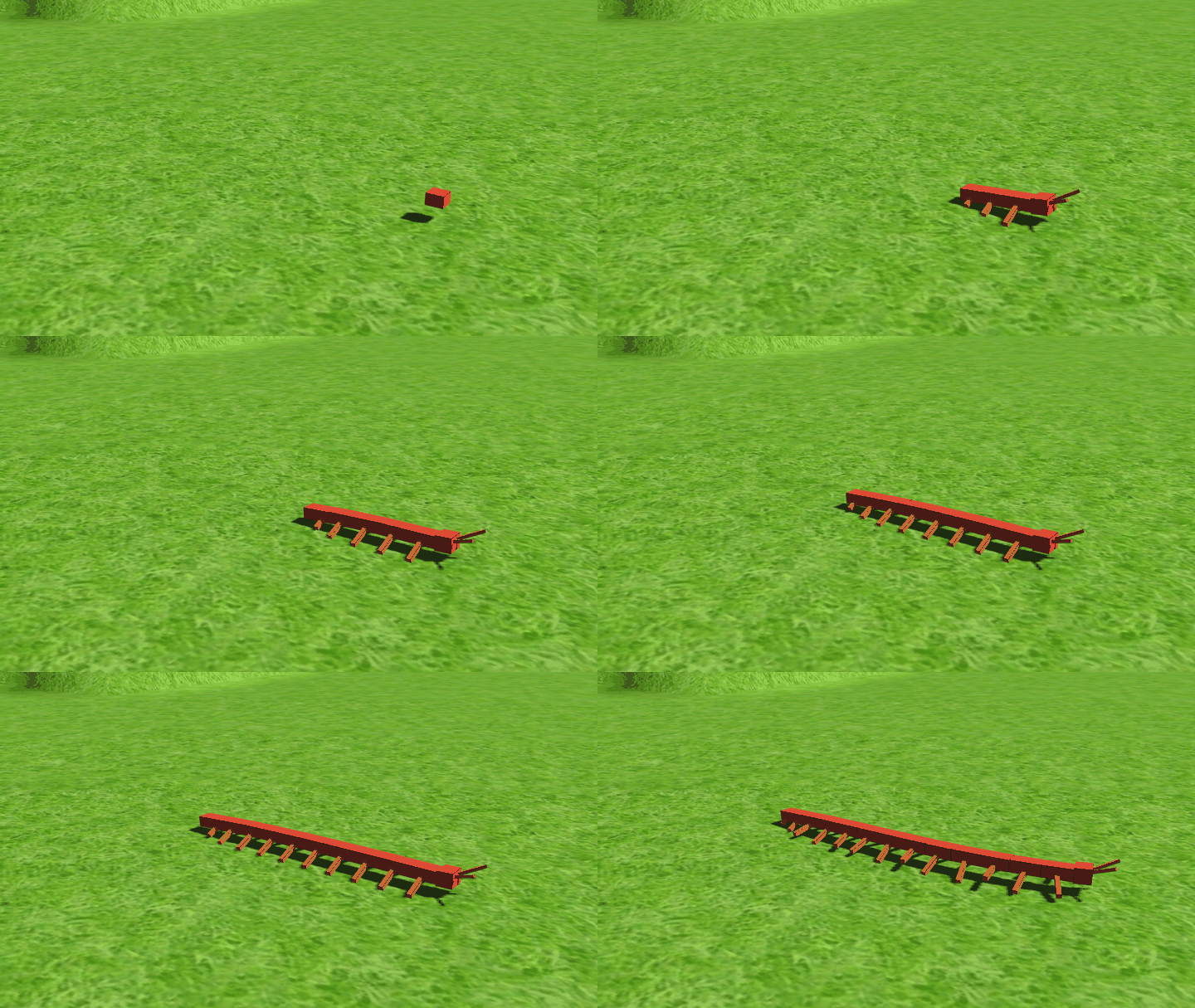
One cube, local rules, contact inhibition before every step. Covered in the growing post; the centipede below is seven rules.
7: Nerves
Neurons live in the part they move and travel with it when limbs are grafted between creatures. Accumulator → threshold → transfer function, strict two-phase update, the shape of the BamZooki engine I worked on in 2001.
A leg can walk with no clock at all – a reflex loop in the Rodney Brooks style.
A small High level brain chooses what to look for; it never moves a joint.
Cheers!