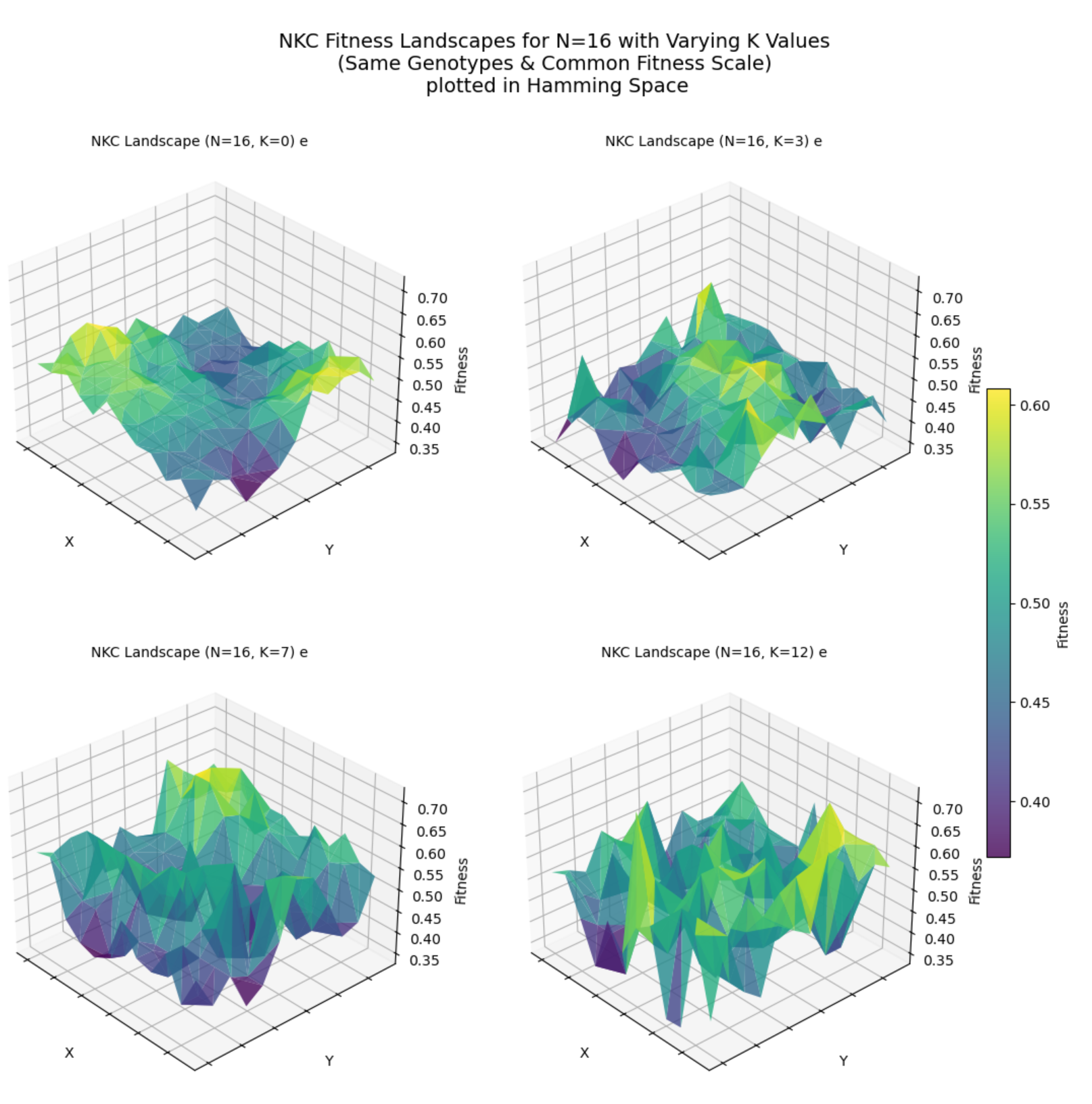
The NK model, developed by Stuart Kauffman, is a useful framework for studying how complex biological, social, or technological systems evolve over time. The key idea is that each of the “N” components in a system adds its fitness contribution to the total, but each of these components’ fitnesses is dependent on the qualities of “K” other elements in the same system
Here is a nice article to describe this model: https://www.econstor.eu/bitstream/10419/217461/1/s41469-018-0039-0.pdf
Stuart Kaufman’s original system is based around a random numbers siting on a hypercube. – which is a challenge to visualise, so historically, the surfaces have been “representations” rather than actual plots, such as this figure from Felipe A. Csaszar

I always found this a little frustrating, so here is my attempt to visualise an actual surface extracted form an NK landscape.
Algorithm:
- Pick a random point on the hypercube.
- attach that n-dimensional position to a 2D position on a grid
- create neighbours on the 2D grid that are not more than a hamming distance of 2 from the first point
- spiral out making more points that are no more than a hamming distance of 2 from any neighbours


Leave a Reply